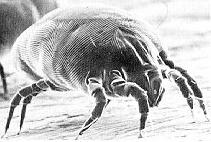
Allergies are very serious business! Why? Beacuse they are indicators for the predisposition to infection and disease. Allergic inflamtion may result in cell injury and bacterial or fungal invasion. This important fact must be understood. Dust mite allergy is a response to a microscopic organism that lives in the dust that is found in all dwellings and workplaces. Dust mite allergens, perhaps the most common cause of perennial allergic rhinitis, usually produce symptoms similar to pollen allergy and can also trigger asthma. Mites are a member of the arachnid family, which includes spiders, chiggers, and ticks. Dust mites are 8-legged spider-like creatures that are about 1/3 of a millimeter in length. There are two species belonging to the genus Dermatophagoides, which are commonly found in North America. Both species feed on human skin, pollen, fungi, bacteria, and animal dander. The food consumption and development of the mites’ increases with higher relative humidity (70 to 80%) and common indoor temperatures (75 to 80 degrees Fahrenheit). Dust mites and their droppings are known allergens. It is a protein in the mites and their feces to which people develop an allergic response. When these droppings come in contact with the skin or are inhaled they may cause allergy, asthma, and/or eczema symptoms. A gram of house dust may contain 100 to 500 mites, and each mite produces 10 to 20 waste particles a day. This waste is extremely tiny and light, and thus is easily aerosolized. Although virtually no environments are free of dust mites there are steps that can be taken to reduce their numbers including - - Encase mattresses, box springs, and pillows in non-allergenic, plastic zippered encasings. Only certain people will develop an allergy to dust mites and their feces. These people can be identified by means of a skin prick test (SPT) or RAST tests done on a blood sample. Desensitization injections (Systemic Immunotherapy - SIT) may be used to treat pure house dust mite allergy that fails to respond to avoidance measures or common medical therapy. www.abcnews.go.com/sections/living/DailyNews /Asthma_000119.html | ||||||||||||||||||||||||||